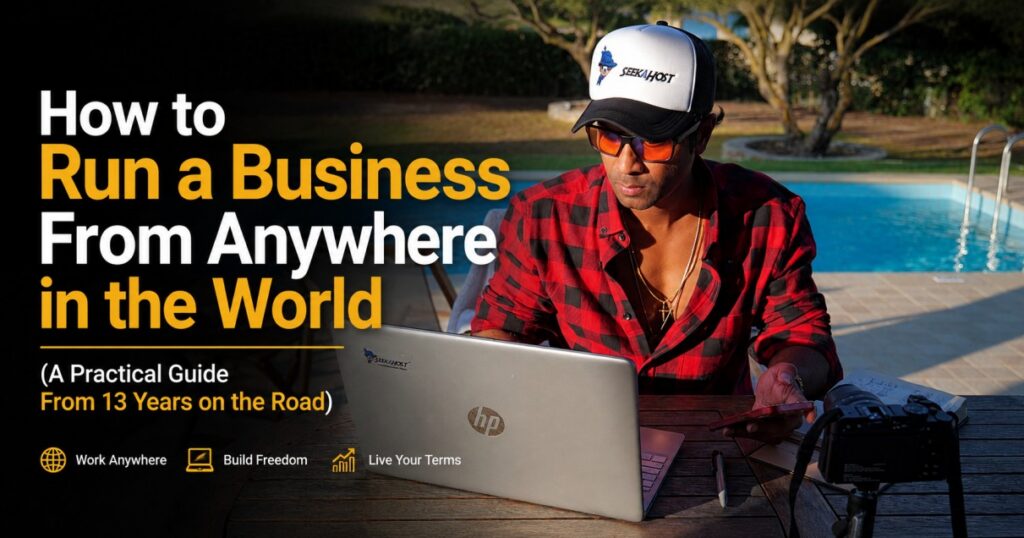
I’m writing this from wherever I happen to be this week, which is kind of the point. My name is Fernando Raymond, and I’ve spent the last thirteen years building and running digital businesses without ever needing to be in one place to do it.
It didn’t start that way. Back in 2013, I’d just come out of an MSc in International Business, done everything “right,” and landed in a string of jobs that looked good on paper and felt wrong in practice. I remember sitting at a desk, watching the clock, thinking: I studied international business, and yet my world has never felt smaller. So I quit. Not with a plan, not with savings that would make sense to a financial advisor, just a decision that I’d rather build something uncertain than keep managing someone else’s certainty.
Thirteen years, several businesses, and more countries than I can list later, I want to write the guide I wish someone had handed me back then. Not the glossy “laptop on the beach” version, but the real one, with the tools, the mindset, and the parts that nearly broke me in the beginning.
Start With the One Thing That Makes Everything Else Possible: Your Own Website
If there’s a single piece of advice I’d give anyone reading this, it’s this: before you chase the business idea, build your home base online. A website or blog under your own name or brand is the one asset nobody can take away from you, algorithm-proof and platform-proof. It’s where clients find you, where your authority compounds over time, and where every other business you launch later has somewhere to point back to.
I wrote about exactly why this matters in Your Name Deserves Its Own Home Online. The short version is that a personal blog isn’t a vanity project, it’s infrastructure. If you’re serious about it, I’d also read Why Tim Ferriss and I Both Bet on Owning Our Personal Blog Domain, and once it’s live, don’t skip the unglamorous step of getting it indexed properly. I walked through that in How to Submit Your WordPress Blog to Google Search Console and Analytics. Every digital business I run today, consulting, courses, content, partnerships, traces back to a blog post someone found first.
Which Businesses Actually Travel Well
Not every business is built for a life without a fixed address, but more qualify than most people assume.
Freelance and consulting work travels easiest. Writing, design, marketing strategy, coaching, coding: anything made on a laptop can be made from a laptop anywhere. This is where I started, taking on marketing consulting projects for clients who never once asked where I was sitting.
Digital products and content platforms are where the real freedom shows up. Courses, e-books, memberships, templates, software: build it once, sell it indefinitely. It’s slower to get going than freelancing, but it’s the version of “passive income” that’s actually real, because the product keeps earning while you’re on a train, asleep, or three time zones away from your last client call.
Professional services delivered remotely (consulting, therapy, financial advice, coaching) have gone fully digital for a huge slice of clients who are just as happy on a video call as in an office.
Hybrid models work too, and I’d never tell someone to burn their existing business down to chase nomadism. If you run e-commerce, a mixed model of held stock plus drop-shipped items lets you scale down operations when you travel without going dark. If you run a client-facing practice, keep a home base for in-person trust and layer remote sessions around it.
The Mindset Nobody Warns You About
Here’s what the highlight reels don’t show you: the first eighteen months were hard in a way that had nothing to do with WiFi or time zones. It was the isolation of making decisions with no manager to validate them. It was the months where income was unpredictable and I ate the same three meals on rotation to make the budget stretch. It was explaining to family why I’d traded a stable salary for a laptop and a plan that existed mostly in my head.
What got me through wasn’t confidence, it was consistency. I treated the discomfort as tuition, not failure. A few things I’d tell anyone starting today:
- Expect a “no income” runway, and plan for it. Give yourself six to twelve months of savings before you go all-in. Nomadism funded by anxiety doesn’t last.
- Your first year is about proving you can finish things, not about finding your one perfect business idea. I built three things that didn’t work before the fourth one did.
- Loneliness is real, so plan for community, not just clients. Co-working spaces, nomad meetups, and cities with existing nomad hubs exist because this matters more than people admit.
- Discipline replaces the office. No one is watching you work. That’s freedom, and it’s also the exact reason most people quit within a year.
What You Actually Need to Run a Business From Anywhere
Once the mindset is in place, the logistics are genuinely simple. Here’s what I never travel without:
Gear. A reliable laptop and a phone, both fully charged, both backed up. I carry a hardware security key for two-factor authentication: if my phone dies or gets lost in a country with patchy replacement options, I still get into everything that matters. A universal power adapter and a spare battery pack are non-negotiable.
Connectivity, with a backup for your backup. WiFi in cafés and co-working spaces is fine 90% of the time. For the other 10%, I tether from my phone, and I carry a second SIM such as Lebara mobile on a different network for the days my primary carrier has no signal. If you’re heading somewhere genuinely remote, satellite internet options have made “no signal” nearly a solved problem, at a price.
A password manager. Every login, every client access, every domain and hosting account lives in one encrypted place I can reach from any device. This alone has saved me more than once.
A VPN, always on. Public WiFi in an airport lounge or a hostel is not secure just because it asks for a password. A VPN gives you your own private tunnel inside someone else’s network. Treat it as seriously as you’d treat locking your front door.
Cloud storage and daily backups. I sync everything and keep a separate backup of my sites running on its own schedule. Losing a laptop should be an inconvenience, never a catastrophe.
A contact form and a booking system on your site. People will want to reach you and book time with you while you’re asleep in a different time zone. Let your website do that work for you with a appointment scheduling software such as TimeTide.app.
The Part People Skip: Time Zones and Legal Footing
Every time zone has a workable overlap with somewhere. I’ve learned to treat my calendar like a puzzle: mornings for clients ahead of me, evenings for clients behind me, rather than assuming I need to be “always on.” The only real dead zones are places nearly a full day apart, like scheduling live calls between Europe and Australia.
And take the legal side seriously. A tourist visa isn’t automatically a work visa, and plenty of countries now offer proper digital nomad visas built for exactly this lifestyle. Spend long enough anywhere and you can trigger local tax residency on top of your obligations at home. None of this should scare you off. It’s a ten-minute conversation with an accountant before a long stay, not a reason to stay put.
Five People Who Prove This Actually Works
I’m not the only proof this model holds up. A few names worth knowing if you want evidence beyond my own story:
- Matt Kepnes (Nomadic Matt) turned a budget-travel blog into a bestselling book and a suite of courses on blogging, photography, and travel: a textbook case of one piece of content compounding into a full content business.
- Pieter Levels built Nomad List and Remote OK by solving his own problem as a traveler first, then opening the tool to everyone else facing the same one, running both without an office and keeping the business lean enough to adapt fast.
- Natalie Sisson, known as the Suitcase Entrepreneur, built her online business while continuously on the move, and has spent years teaching others how to structure theirs the same way.
- Chris Guillebeau wrote The $100 Startup while working toward visiting every country in the world before turning 35, proof that a low-cost, laptop-driven business and serious travel aren’t mutually exclusive.
- Fred Perrotta and Jeremy Michael Cohen, co-founders of Tortuga Backpacks, came up with their product idea while backpacking through Europe and built a real e-commerce brand around solving a problem they’d lived through themselves.
None of these are overnight stories. Every one of them put in years before the freedom part looked effortless from the outside.
A Thousand-Mile Business Starts With a Single Post
If you take one thing from this article, let it be this: location independence isn’t about the destination, it’s about the systems you build before you ever board a flight. Get your website up first. Get your access, your backups, and your security sorted. Then let the business, whether it’s freelance work, a digital product, or a consulting practice, grow around a life you actually want to live, instead of shaping your life around a desk you never chose.
I built this from nothing after deciding my degree and my job title weren’t going to define where I lived or how I worked. If you’re at the start of that same decision, I’d genuinely love to help. Explore more of what I’ve written on fernandoraymond.blog/posts, and reach out. I answer every message from people serious about building this for themselves.
See you out there.